Saturday, August 28, 2010

3. Tale of the Tiger that ate Grandpa Wildsnake's Child

A long time ago, there lived an old man named Grandpa Wildsnake who was a very poor farmer working by the foot of a mountain with his wife. It took them a long time to have a child, a son who they lovingly raised from infancy until he safely grew to one year of age.

One day Grandpa Wildsnake and his wife left the boy in their hut to sleep after feeding him, like they had done many times before without incident. They took their farm tools and went to work in the field from morning until noon, leaving the child to sleep by himself. As soon as Grandpa and Grandma were out of sight, a large tiger who lived in the nearby mountain jungle snuck into the hut. Seeing the child sleeping alone, he decided to take the child with him to eat as a meal. The child did not even cry since he was still sound asleep.

Grandpa Wildsnake and his wife kept busy working hard under the hot sun harvesting the rice since morning without resting for even a moment. By afternoon, when they could no longer tolerate the heat from the sun, they collected their rice harvest into bundles and tied them together. Grandpa Wildsnake lifted the bundles onto his shoulder and walked home behind Grandma, who was carrying her bundles on her head. After they got home and set down their harvest bundles, they looked into the house and did not see their child. Both husband and wife felt immediate despair and despiration. By the place where they kept their child, they saw only the print of a large tiger's foot. From the place their child slept all the way to the foot of the jungle were blood drops. Grandpa Wildsnake and his wife knew for certain that the tiger had taken their son to eat and felt deep sorrow for their small helpless child.

Everyday from dawn until dusk, Grandpa Wildsnake and his wife experienced no joy. They reflected on their situation saying, "Spending our time constantly crying and pitying ourselves serves no purpose whatsoever. We should stop weeping and wailing and think about a foolproof way to kill that tiger." The next morning, after resting their tired spirits, they set their sights on finding and killing the tiger that ate their child. From that day forth, every morning Grandpa Wildsnake's wife woke up at dawn to prepare food and water for her husband so that everyday he could pursue the savage tiger that took the life of their child. And so, each morning, after his wife finished preparing and packing food for the day, Grandpa Wildsnake would leave for the mountain jungle. On one shoulder he would carry his small bag of food; on the other shoulder he would carry his ax as he walked into the mountain.

Grandpa Wildsnake searched for that tiger from the foot of the mountain to its peak, looking for it behind every rock, small or large, across thick woods and open meadows, from open meadows back into thick woods. He looked for that tiger from the dry season until the rainy season, when the monsoons flooded the fields to the foot of the mountain. Fearing they would drown, all the animals in the jungle ran onto the mountain to find shelter.

One day, as Grandpa Wildsnake was walking, he caught sight of the tiger that ate his child. He thought to himself, this is surely the tiger that ate my child because the footprint that I saw and this tiger's feet are about the same size, and I have never seen another tiger as large as this one. Only the largest of tigers would dare enter my home and eat my child in broad daylight. Grandpa Wildsnake considered, if I try to use brute strength to kill this tiger, there is no way I can win. To succeed, I must use my wit and wisdom. With this in mind, Grandpa Wildsnake spoke loud enough for the tiger to overhear, saying: "Use small vines to tie up pots and pans, use long vines to tie up family members onto the trees." As he spoke, his eyes kept watch all around. His right hand held the ax, his left hand pulled on the vines acting as if he was really collecting vines. He continued in this manner until the tiger took notice.

Tiger became curious and asked Grandpa Wildsnake, "Grandpa, what are you taking all those vines to tie up?" Grandpa Wildsnake replied, "I am taking the vines to tie up my pots and pans, my family members, to hang them from the trees, because in only 2 days from now the waters that have flooded the fields and flooded the jungles will flood the mountain killing everyone, including you." Upon hearing this, Tiger became fearful of drowning and pleaded for Grandpa Wildsnake to tie him up to a tree as well. Grandpa Wildsnake refused saying, "I will not tie you to the tree, Tiger. I will let you drown. If you do not believe me, climb onto the highest boulder and look down the mountain and you will see the waters that are rising all around."

Tiger quickly ran to the highest boulder he could find at the top of the mountain and saw the flood waters just as Grandpa Wildsnake described. Hebecame desperately frightened and ran back down to find Grandpa Wildsnake and begged him again and again, pleading Grandpa to tie him up to a tree. Grandpa Wildsnake taunted Tiger saying, "I am willing to tie you up but I will use only the small vines so that you will fall into the flood waters and die." This compounded Tiger's fright as he continued to beg Grandpa Wildsnake, pleading with his paws pressed together in prayer. Grandpa Wildsnake, viewing the situation as ripe, said to Tiger, "Don't worry, Tiger. I will find an extra large vine to tie you up." Hearing this made Tiger excited with joy.

Grandpa Wildsnake instructed Tiger to lie down, then took a very large vine and tied Tiger's four legs together and tied him up to a tree just high enough that a club could reach him. Afterwards, Grandpa Wildsnake went to find the largest club he could in order to beat the tied-up tiger. When Tiger saw Grandpa Wildsnake chop at a tree to make himself a club, he became curious and asked, "Grandpa, grandpa! Why are you chopping away at that wood?" Grandpa Wildsnake lied saying, "I'm chopping the wood in order to make a yoke to carry the vines back home." After Grandpa Wildsnake finished chopping the wood into a club, he went and beat Tiger from that afternoon until nightfall, breaking Tiger's ribcage until it caved in, using both hands to wield the club as he exclaimed, "Take that Tiger! See if you'll ever bite a child of mine again."

No matter how hard Tiger struggled, he could not get loose. After the beating, Grandpa Wildsnake collected kindling and firewood into a pile beneath the tiger and set fire to it, singeing Tiger's fir and burning patches of skin. The vines that held up the tiger caught fire and eventually broke, dropping Tiger to the ground, whereupon he dashed off into the thicket. Grandpa Wildsnake returned home and told the tale to his wife of how he beat the tiger with satisfaction. Thereafter, he lived contently with his wife until the end of their lives.

From this story comes the explanation for why tigers today differ from all other animals in the following 3 ways:
Whenever a tiger dies, its rib cage appears as if it has caved in.

The tiger prays twice a day that it will not encounter us humans, fearful of people since the day Grandpa Wildsnake tied and beat it up.

The tiger's markings come from being burned by the fire set by Grandpa Wildsnake

2. Tale of Rabbit Stuck on a Tree Trunk

One day, Rabbit was foraging for food when he unexpectedly ran into the base of a Trach tree that was recently chopped down and caked in sticky resin. Rabbit jumped onto the resin and got his tail and feet stuck. Unable to move, he remained motionless there on the stump of that tree.

In time, along came a baby elephant seeking to drink water at the pond by that Trach tree, a place where he went to drink everyday. Rabbit, having intelligence, spoke to frighten the baby elephant saying, “Neh! You, Baby Elephant! Do not drink this water of mine. This water the Great Lord Indra has ordered me to guard.” The baby elephant was scared and did not drink. Instead he returned to his mother crying, “Oh Mother! I was going to drink water from the pond when I saw some kind of animal sitting on a tree stump. It ran me off, prohibiting me from drinking the water. It said that it was in the service of Indra. I am very thirsty Mother!”

The mother elephant, listening to her child tell the story, grew angry and took him to the pond where they saw Rabbit sitting on the tree stump. Yelling in a threatening manner, Elephant said, “Yuh! You mean little rabbit, from where do you come from to end up sitting on this tree stump? What power do you have to prohibit and prevent my child from drinking this water? I’ll stomp on you and smash you to bits right now.” Rabbit responded by saying, “Yuh! You big windbag, you have the nerve to scold me? This pond water the Great Lord Indra has ordered me to guard, that is why I dare to prohibit others from drinking it.”

Elephant grew even angrier at Rabbit for cursing at her in this manner. She lunged forward at the stuck rabbit and pushed him off the tree trunk, planning to toss and kill him. A very frightened Rabbit screamed, “If you toss and kill me, do not toss me to the ground. I will not die that way. Throw me up instead, then I will die.” Elephant, lacking intelligence and hearing Rabbit speak thusly, threw Rabbit up into the air. When Rabbit fell to the ground, he darted off and disappeared into the jungle.

Khmer Folktales

1. Tale of Vulture Duping Elephant


In the distant past, there was once a vulture king who had a powerful army of warriors at his command. One night that vulture king dreamt in his sleep that he had captured the white elephant king. The next day, he sent his warriors to the realm of the white elephant king, and upon reaching their destination they called to the elephant king saying, “Brother Elephant! Our master has ordered you to immediately come with us to our domain because our master understands his dream to mean that he should eat your flesh.” Upon hearing these words, Elephant became startled and frightened. He cried as he bid farewell to his wife and children, and followed the warriors as ordered by the vulture king.

Midway through their journey, they came upon a wise rabbit judge who asked the elephant king, “Yeh! Where are you going, Brother Elephant, that you should be in such a rush and weeping uncontrollably as you go?” Elephant replied telling Judge Rabbit his ordeal. “Ye! Brother Elephant, as large as you are, why do you freely agree to permit yourself to be eaten by a vulture? I will help release you from your suffering so that you may be free to live,” said Rabbit. The elephant king, hearing Rabbit speak thusly, became very happy and invited Rabbit to ride on his back as they walked toward the dominion of the vulture king.

Upon seeing Elephant’s arrival, the vulture king became very gleeful and giddy and exclaimed, “Ey! Brother Elephant has finally arrived! We must eat you this day because we understand our dream to say that we should eat your flesh.” As Vulture spoke to Elephant, Rabbit acted as if he were asleep on top of Elephant. The vulture king then looked up at Rabbit and yelled, “Neh! Brother Judge, what are you doing sleeping on Elephant’s back like that? Get down from there quickly, as we are about to eat Elephant.” Rabbit responded saying, “Stop, stop! Not yet! Brother, what did you say to Brother Elephant just now? I did not get to listen because I was too busy sleeping.” Vulture answered, “I had a dream in which I ate white elephant meat.” “Ey! Really,” said Rabbit, “just now as I was asleep I dreamt that I slept with your wife, King Vulture.” “Yuh, Brother Judge! We do not need to give our wife over to you,” said the vulture king. Rabbit retorted, “If you do not permit me to live out my dream, then your claim is equally unenforceable, and neither will I permit you to eat Elephant.”

Vulture therefore did not get to eat elephant meat due to his defeat by Judge Rabbit’s clever ruse. White Elephant went ahead and returned to his dominion. Rabbit hopped back into the forest and disappeared.

Pchum Ben (Prachum Benda) Festival “Ancestors’ Day” History

In Cambodia, there are various religious festivals. Among those, Prachum Benda (“ Ancestors’ Day” ), more commonly known as Pchum Ben, is a big Cambodian religious festival, culminating in celebrations on the 15th day of the tenth month in the Khmer Calendar. It lasts for fifteen days. Pchum Ben is the fifteenth and final day of the ceremony and consists of a large gathering of laity for festivities at the local Buddhist temple. The days leading up to Pchum Ben are known as Kann Ben. In 2007, the holiday falls on the 11th of October in the Gregorian calendar.

Religiously, Cambodians believe that although most living creatures are reincarnated at death. However, due to bad karma, some souls are not reincarnated but rather remain trapped in the spirit world. Each year, for fifteen days, these souls are released from the spirit world to search for their living relatives, meditate and repent. So, the fifteen-day is time when Cambodians pay their respects to deceased relatives. Furthermore, it is an important opportunity for living relatives to meditate and pray to help reduce the bad karma of their ancestors, thus enabling the ancestors to become reincarnated and leave the torment and misery of the spirit world. People cook meals for monks, bring offerings to the temple and throw rice near the temple early in the morning, believing that their ancestors will receive it.

Terminology:
Prachum Benda (Pchum Ben): means “gathering together to make offerings”
Prachum (Pchum): means “gathering together”
Benda (Ben): means “offering”
Kann: means “ hosting or holding”


Cambodia Water Festival Highlights

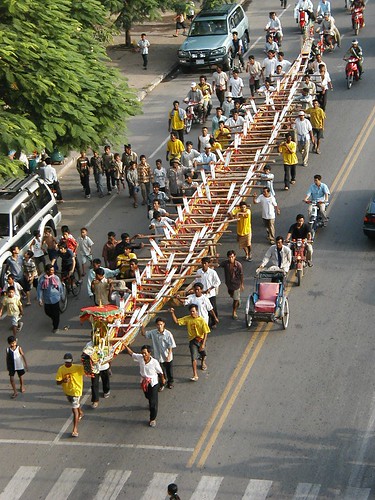
The Water Festival (”Bon Om Tuk”), the most exuberant festival in Cambodia, took place on November 15-17th. According to Jinja, the Festival marks the start of the dry season and of Bon Kathan (a Buddhist practice done yearly where new robes are offered to monks).
Up to a million people from all walks of life and from all over the country flocked to the banks of the Tonle Sap and Mekong Rivers in Phnom Penh to watch traditional boats racing. As Phatry notes about the crowds, “I woke up amazingly late at 10 in the morning. already, hundreds of thousands phnom penhois, country folks, and tourists swell the waterfront and independence monument area. “

Hundreds of boats and paddlers will compete, including a boat team of HIV-positive men and women.

According to Jinja, many villages send a boat team to Phnom Penh. The village boat is usually stored at a community temple ('Vat') and the team begins practicing in the months before November. Companies, nonprofits, associations and groups of friends assemble boat teams.
There is great pride for the local village boat team. As KhmerAK notes,”People going to see the boat racing along the river and especially giving support to the one comming from the province where they from, and maybe me too, going to support the one from my province . . .”
In addition to the photograph above, Jinja captured some amazing photos of the Water Festival boats. He also photographed some of the illuminated boats on the river in the evenings, like this one:
Meanwhile, Cambodian bloggers living out of country, like Wanna, are reminded of the Water Festival.

Tuesday, August 17, 2010

Cambodia Times: Camodia Preface

Cambodia Times: Camodia Preface: "Cambodians comprise a variety of kids who are commonly called Khmer. The Khmer constitute about 91 percent of the population. The population..."

Life in Cambodia: Living Conditions & Farming

“I now think of Pursat and the project that we have set up there. This time, I visited Pursat in a different manner. This time we did not just base ourselves at the Sylvia Lasky Memorial School, an open aired building which provides free English classes twice a day to one hundred students. Instead, we went to the homes of many of the families in the project. It was at that time that another level of Cambodia life opened itself up to me.

I say that we visited the homes. But these were not really homes, they were solely shelters from the elements. These shelters where simple grass and bamboo structures, one room with no electricity or running water, usually with straw mats to sleep on.

The families that live in these huts are rice farmers but have only a basic subsistence living. Few own their own land, many of them having sold whatever ownership they may have once possessed after a series of floods and droughts ruined their yearly rice crop. As there is no legal control on money lending, persons in need must often take out loans at eighty to one hundred percent interest on the value of the loans. When farmers do this to simply feed their families and have a bad crop, they lose everything.

Now these families rent another person’s land. In exchange for this use, they give the owner a shocking thirty to forty percent of the profit from their rice. As they must first pay back the landlord for use, the rice the farmers grow often does not even go to feed their own families. The extended and bloated bellies of many of the under-nourished children who stared, cried and waved at us as we wandered through their village was a testament to this sad fact.”

Sustainable Cambodia has now started buying the rice supplements for the most indigent families from the farmers who produce enough rice to sell and whose children are in the program. By cutting out the middleman at the rice mill we are getting more rice for the families and giving the farmers more money than they would get from the mill. These are the types of "win-win" capacity-building solutions we are seeking in our work in Pursat.